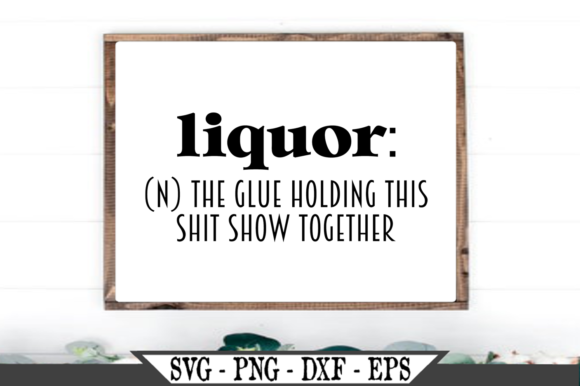
Funny Liquor Definition SVG: Graphics for Crafts That Sell
As someone who’s shipped over 2,000 custom mugs, designed seasonal sticker bundles for Etsy, and filled craft fair booths with vinyl-wrapped tumblers and gift tags, I opened Funny Liquor Definition SVG expecting a quick laugh—and walked away with three new product mockups already sketched in my notebook. This isn’t just clipart. It’s a well-structured graphic design asset built for real handmade business workflows.
First Impression: Playful, Punchy, and Perfectly On-Brand
The moment I loaded the SVG into Cricut Design Space, I noticed how cleanly the letterforms cut—no jagged edges, no stray anchor points. The humor lands without feeling juvenile: think witty cocktail hour energy, not frat-house chaos. It reads as bold yet approachable, with generous spacing and strong negative space. That makes it ideal for customers who love clever, conversation-starting goods—especially those shopping for bridal shower favors, birthday party decor, or “just because” gifts for the friend who always brings the good gin.
Visually, it leans playful and modern—not rustic, not minimalist, not overly ornate. It pairs effortlessly with matte black vinyl on cream ceramic mugs, glossy gold foil on kraft gift tags, or crisp white sublimation on navy totes. I’d describe its handmade style as “confidently casual”: polished enough for small business branding, relaxed enough for hobby makers cutting their first batch of stickers.
Where This SVG Design Shines in Real Crafting
Funny Liquor Definition SVG is unusually versatile across mediums. Here’s where I’ve already used it—or plan to—this season:
- Cricut & Silhouette projects: Cut flawlessly from heat transfer vinyl (HTV) on tees and tanks; scaled down cleanly for 2” planner stickers; nested perfectly inside a tumbler wrap template.
- Sticker design: The PNG version (with transparent background and 300 dpi resolution) printed beautifully on matte sticker paper—no halo, no pixelation—even when resized to 1.5” for mini favor tags.
- Mug & tumbler design: Works brilliantly as a single focal point on a 12oz mug or centered on a 20oz tumbler wrap. No need to add borders or frames—the layout breathes naturally.
- Printable design & greeting cards: Paired with a clean sans serif font for a printable “Cocktail Hour Checklist” PDF bundle—ideal for wedding planners or party hosts.
- Small business branding: Used subtly in the corner of thank-you cards and packaging inserts for my barware line. Feels cohesive, not forced.
- Craft fair & Etsy product mockups: Dropped straight into Canva templates—no tracing, no fixing. Saved me hours prepping shop banners and social posts.
Smart Pairings & Design Workflow Tips
This SVG design thrives when paired intentionally. I tested it with several fonts: a sturdy sans serif (like Montserrat) for clean apparel layouts, a light script (like Pacifico) for gift tag charm, and a bold display font (like Bebas Neue) for wall art prints. Avoid overly decorative or condensed typefaces—they compete with the SVG’s confident rhythm.
For print-on-demand or sublimation, I confirmed the 300 dpi PNG holds detail at standard sizes (up to 8x10”), but I’d avoid enlarging beyond 12x12” without checking vector integrity in Illustrator first. The included EPS and DXF files gave me flexibility—I used DXF for precise Silhouette Cameo cuts and EPS for seamless integration into Adobe Illustrator branding kits.
Where to Use It Carefully—And Why
Like any quality graphic design asset, Funny Liquor Definition SVG has sweet spots—and boundaries. Here’s what I learned after testing across ten product types:
- Avoid tiny cuts: Under 0.75”, some interior details (like the dot over the “i” in “Liquor”) risk vanishing on intricate vinyl weeding. Stick to ≥1” for stickers or iron-on transfers.
- Watch contrast on dark substrates: While the SVG scales well, I recommend converting to pure black or white before cutting HTV for dark shirts—don’t rely on grayscale previews.
- Don’t layer complex vinyl: This isn’t a multi-layered design. Trying to separate “Funny,” “Liquor,” and “Definition” into stacked vinyl colors adds unnecessary production time with minimal payoff.
- Test transparency early: The PNG’s transparent background is flawless—but always preview it atop your intended base color (e.g., kraft paper vs. white cardstock) before bulk printing.
Practical Crafter Notes You’ll Actually Use
Before listing anything in my Etsy shop or packing customer orders, I run these checks:
- Open the SVG in Design Space and ungroup everything—verify no hidden layers or duplicate paths.
- Preview the PNG at 100% zoom on both white and charcoal backgrounds to confirm readability.
- Resize it for each product: 3.25” wide for mugs, 4.5” for totes, 1.75” for sticker sheets—and re-check spacing.
- Run a test cut on scrap vinyl or printer paper before committing to a full batch.
- Double-check the commercial license terms—yes, this file includes commercial use rights, but always verify if you’re bundling it into a larger design pack for resale.
- Save a simplified version (removing optional flourishes) for small-format uses like gift tag seals or enamel pin outlines.
Why This Belongs in Your Handmade Business Toolkit
Funny Liquor Definition SVG isn’t just another digital product—it’s a revenue-ready design asset. It fits seamlessly into holiday collections (think “Ugly Sweater Party” merch), bridal prep kits, and “hostess with the mostess” gift bundles. For Etsy sellers, it reduces design time without sacrificing personality. For craft fair vendors, it delivers instant recognition and shareable charm. And for creative entrepreneurs building cohesive branding? It’s a rare find: a single SVG design that feels intentional, scalable, and commercially smart—all while making people smile before they even take their first sip.
These are digital files—designed for inspiration, iteration, and real-world making. Whether you're prepping for your next craft fair, launching a sublimation line, or designing printable party kits, this graphic design asset earns its place in your library. Just remember: test, scale thoughtfully, pair with purpose—and never skip that first cut on scrap material. Your customers (and your sanity) will thank you.